

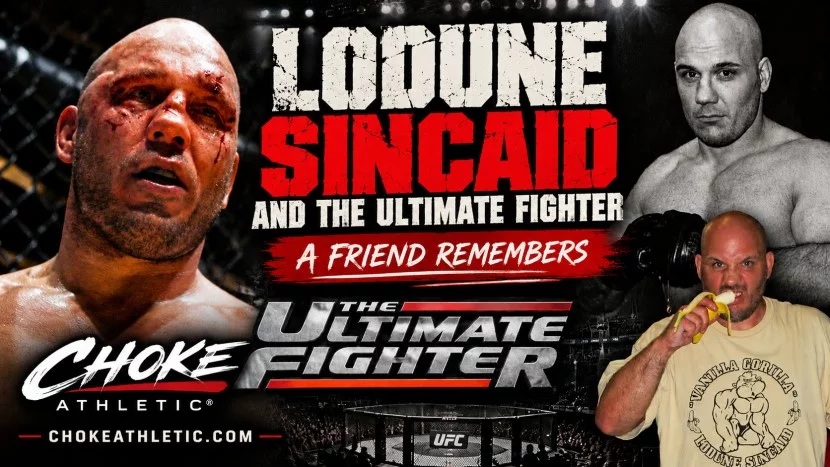
A personal story about my friend Lodune Sincaid, the wild beginnings of The Ultimate Fighter, and the television experiment that helped change MMA forever.
I still remember when Lodune Sincaid first told me he was going to be on a new television show called The Ultimate Fighter. I had a hard time wrapping my head around the whole concept. They were going to take a bunch of professional fighters, put them together in a house, have them train and compete against each other, and film everything that happened along the way. Throw in what sounded like an unlimited supply of alcohol, and who knew what the hell was going to happen? It sounded like a recipe for either a brilliant television show or a complete disaster. Maybe both. And knowing Lodune as well as I did, I had a feeling he was going to make things interesting.
What made the situation even more remarkable was what was happening in Lodune’s life when he got that call. He had just lost his apartment and was basically sleeping in his car. He’d been drinking for weeks and hadn’t been training. Lodune also lived with bipolar disorder, and I’d seen firsthand how difficult things could get for him. He was my friend, and I knew there was a lot more going on in his life than most people would ever see on television. Now, here he was, getting an opportunity to appear on a major cable network at a time when things weren’t going particularly well. I couldn’t help wondering how this was going to play out.
Before MMA Became a Household Name
You have to remember what mixed martial arts looked like back then. Those of us who had been around the No Holds Barred and Vale Tudo scene were accustomed to seeing some pretty unusual characters. There were tremendous athletes, legitimate martial artists, tough guys, and more than a few personalities who seemed better suited for a sideshow than a professional sporting event. That’s not a criticism. It was part of what made those early days so interesting. The sport was still finding its identity, and nobody had figured out how to package it neatly for a mainstream audience. Frankly, a lot of us weren’t particularly interested in seeing it packaged neatly in the first place.
The UFC had been struggling to get a foothold in mainstream American sports, and the idea of a reality show built around fighters was a considerable gamble. The Ultimate Fighter premiered on Spike TV on January 17, 2005, with Randy Couture and Chuck Liddell coaching two teams of aspiring UFC fighters. It followed WWE’s Monday Night Raw, giving the new program exposure to an audience already interested in combat and larger-than-life personalities. Instead of asking people to purchase a pay-per-view featuring fighters they knew little about, the UFC was letting viewers get to know those fighters over several weeks. Whether that strategy would work was anybody’s guess.
And what a collection of personalities that first season turned out to have. Chris Leben, Forrest Griffin, Stephan Bonnar, Diego Sanchez, Josh Koscheck, Kenny Florian, and the rest of the cast gave viewers plenty to talk about. Some were naturally entertaining. Others probably had no idea just how entertaining they were. The audience watched them train, argue, compete, and deal with the frustrations of living together. There was some ridiculous behavior, plenty of drama, and occasionally some excellent fighting. It wasn’t always a flattering look at the sport, but it was certainly a look that people hadn’t been getting before.
Lodune Sincaid Makes Ultimate Fighter History

Lodune ended up making a little piece of MMA history of his own. He was selected to fight Bobby Southworth in the first elimination bout of the very first season. Think about that for a moment. Of all the fighters who would eventually appear on The Ultimate Fighter over the years, Lodune was one of the first two to compete in an elimination fight. Unfortunately, things didn’t go his way. Southworth knocked him out early in the second round, ending Lodune’s chance of winning the competition. It certainly wasn’t the outcome he’d hoped for, but there is something to be said for being part of the very first fight in a television series that would go on to become so important to the sport.
Lodune returned for the live finale on April 9, 2005, where he faced Nate Quarry in his UFC debut. Quarry stopped him in the first round. Those two appearances are what many fans remember about Lodune, but they were hardly the whole story of his fighting career. He continued competing and, in 2006, won the WEC light heavyweight championship by submitting Dan Molina. That doesn’t always get mentioned when people look back at the first season of TUF. Lodune was much more than a colorful reality television personality. He was a legitimate fighter who had earned his opportunities, regardless of the personal difficulties he was dealing with along the way.
The Television Experiment That Changed Everything
Meanwhile, something extraordinary was happening with the television show itself. People were watching. Lots of them. By the end of the season, millions of viewers had become invested in fighters whose names they might never have recognized a few months earlier. The live finale attracted approximately 2.6 million viewers, and the Forrest Griffin versus Stephan Bonnar fight became one of the most talked-about moments in UFC history. That fight deserves its reputation, but I think people sometimes overlook everything that led up to it. Viewers had spent weeks getting to know these guys. They weren’t just watching two strangers beat the hell out of each other. They had a reason to care who won.
The impact on the UFC was enormous. The show introduced mixed martial arts to an audience that might otherwise never have purchased a fight or walked into an MMA gym. Suddenly, people who had never followed No Holds Barred fighting were talking about submissions, wrestling, and the differences between fighting styles. The UFC was no longer depending entirely on dedicated fight fans to keep the business going. Television had opened a door that the sport had been trying to get through for years. And Lodune, of all people, had been there for the beginning of it.
When everything was said and done, Lodune offered to send me one of his Ultimate Fighter shirts. Instead, I asked him to get me one of the Spike TV shirts they’d made for the show’s television debut. He did. At the time, it was just a cool shirt connected to something my friend had been involved in. We weren’t sitting around discussing the historical significance of that first season. We were simply living through it, watching things unfold, and wondering what might happen next. Looking back now, that shirt represents a moment when MMA was changing in ways that very few of us fully understood.
One Last Reunion
In 2018, the UFC organized a reunion of the original Ultimate Fighter cast as part of its 25th-anniversary celebration. Lodune and I talked about it, and we also tried to get hold of Jason Thacker, better known to viewers as “Strange Brew.” We weren’t successful in reaching him. Lodune, meanwhile, wasn’t interested in attending the reunion. We discussed it, but he was pretty firm about not wanting to go. I would have liked to have seen him there with the other guys, sharing stories about something that had become such a significant chapter in MMA history. It just wasn’t something he wanted to do.
On April 7, 2019, Lodune passed away at the age of 45. Even now, that is difficult for me to write. When I think back on those early conversations about The Ultimate Fighter, I don’t remember them as discussions about the future of mixed martial arts or the beginning of a television phenomenon. I remember talking to my friend about some crazy show he was going to be part of. There were a lot of good times over the years, plenty of laughs, and more than a few difficult moments. Lodune’s life was complicated, but he was my friend, and I miss him.
Before he died, I promised Lodune I would bring Choke Athletic back. That promise is one of the reasons the brand exists again today, and why preserving stories like this matters to me. There are plenty of websites that can tell you who won a fight, what round it ended in, or how many people watched it. Those things are important, but they aren’t the whole story. Sometimes the memories that matter most are the ones that never made it onto television.
When Lodune first told me about The Ultimate Fighter, neither of us knew what it would become. We certainly didn’t know that people would still be talking about that first season more than twenty years later.
And somewhere in the middle of all that history, my friend made sure I got the Spike shirt.
I miss him.
Choke Athletic — Est. 1994
The Fightwear. The Fighters. The History.