

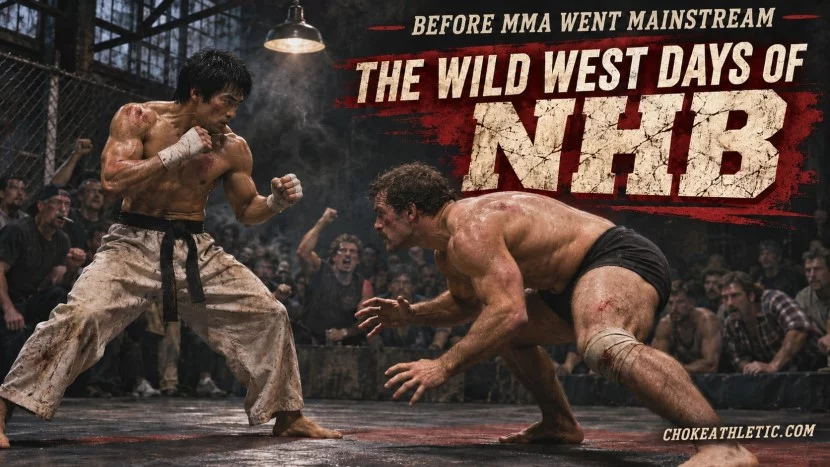
Back When Martial Arts Styles Collided, Nobody Had All the Answers, and the Sport Was Still Finding Its Feet
There was a time when you could walk into a martial arts school, ask an instructor how his style would do against a wrestler, and get a twenty-minute explanation about why nobody would ever manage to take him down. If you asked a boxer what he’d do against somebody trying to choke him, you might get an equally confident answer. Everybody seemed to know what would happen in a real fight, and depending on which school you attended, the answer usually involved whatever that instructor happened to be teaching.
Then the 1990s came along, and a lot of those theories started getting tested.
I’m not suggesting that martial artists had never challenged one another before. They certainly had, and some of the people I trained with had been doing exactly that for decades. But the emergence of No Holds Barred fighting, the early Ultimate Fighting Championship, and the growing visibility of Vale Tudo and submission fighting brought those questions to an entirely new audience. Suddenly, people who’d spent years arguing over which martial art was superior could watch practitioners from different backgrounds compete under a relatively permissive set of rules.
The results weren’t always what anybody expected.
For those who weren’t around then, it’s difficult to explain just how different the martial arts landscape was before mixed martial arts became a mainstream professional sport. There were no universally accepted training formulas, relatively few gyms offering the integrated programs we recognize today, and no guarantee that the fellow standing across from you had trained anything remotely resembling your own style.
That uncertainty was part of what made it so fascinating. It was also part of what made the early days a little crazy.
Before the UFC, Martial Artists Were Already Testing Each Other
I grew up in Los Angeles during the 1970s and ’80s, when Southern California was practically overflowing with martial arts talent. You had boxing, judo, karate, kickboxing, wrestling, kung fu, and all sorts of other disciplines being taught by people whose names were already familiar to serious martial artists.
I was fortunate enough to train with people like “Judo” Gene LeBell and Benny “The Jet” Urquidez. Those were formative experiences, and they gave me a healthy appreciation for people who could actually perform what they taught. They also made it difficult to take some of the more extravagant claims in martial arts advertising particularly seriously.
One of the things people sometimes forget is that cross-training didn’t suddenly appear when the UFC started. There were already practitioners experimenting with different ranges of fighting, combining techniques, and testing their abilities against people from other backgrounds. Gene LeBell’s grappling experience and Benny Urquidez’s striking career belonged to different competitive traditions, but both reflected an emphasis on techniques that had to work against resisting opponents.
The Gracie family had also been demonstrating and testing its approach to fighting long before American audiences encountered Royce Gracie in the Octagon. In Southern California, challenge matches and hard sparring between practitioners from different backgrounds weren’t unheard of. If somebody wanted to test himself at a place such as Gokor and Gene’s, the opportunity to discover what he didn’t know could be surprisingly educational.
Of course, challenging someone and actually being prepared for what happens afterward are two different things. Plenty of people discovered that knowing how to throw a punch didn’t necessarily mean knowing how to stop a takedown. Others found that being a talented grappler didn’t automatically make the prospect of getting punched in the face enjoyable.
We were learning that there was an enormous difference between understanding a technique and applying it against someone who was determined to stop you.
UFC 1: When the Argument Went Public
On November 12, 1993, the first Ultimate Fighting Championship took place at McNichols Sports Arena in Denver, Colorado. The premise was remarkably simple: bring together fighters representing different martial arts backgrounds, put them into an eight-sided enclosure, and see what happened.
The early UFC wasn’t structured like today’s professional mixed martial arts competition. There were no weight classes at UFC 1, no judges deciding close contests, and none of the familiar rounds and standardized regulations that now define the sport. The advertising emphasized the anything-goes atmosphere, although the event did have some restrictions. It was a tournament designed as a direct test of fighting styles, and the spectacle was unlike anything most American television viewers had previously seen.
Then Royce Gracie walked into the Octagon wearing a white gi.
Royce didn’t look particularly intimidating beside some of the larger competitors. There were men in that tournament who appeared considerably more dangerous based on size and physique alone. But he demonstrated something that relatively few members of the viewing audience understood at the time: once a fight went to the ground, the person who knew how to control positions and apply submissions could have a tremendous advantage over somebody who didn’t.
He defeated Art Jimmerson, Ken Shamrock, and Gerard Gordeau in a single evening to win the tournament.
For martial artists unfamiliar with Brazilian Jiu-Jitsu, that was a revelation. For people who’d already been exposed to serious grappling, it was considerably less surprising, although the visibility was extraordinary.
The important lesson wasn’t that Brazilian Jiu-Jitsu had somehow rendered every other martial art useless. It was that the rules of engagement had changed. Techniques that worked beautifully under one competitive format could become liabilities under another, particularly when the opponent had skills that weren’t part of your training.
There were plenty of martial artists who didn’t like that lesson.
Some were embarrassed by it. Others became defensive. A few decided that what they’d seen was a fluke and that the next representative of their discipline would straighten everything out.
Meanwhile, the smart ones started looking for a place to learn how to grapple.
Everybody Was an Expert Until the Fight Started
One of the most entertaining things about the early NHB years was the confidence.
You’d meet someone who’d spent twenty years studying a traditional martial art and was absolutely certain that no wrestler could take him down. Then you’d meet a wrestler who couldn’t understand why anyone would bother learning submissions when he could simply put a man on his back. A boxer might be convinced that one clean punch would end any fight, while a submission specialist assumed getting to the ground was inevitable.
Sometimes they were right.
Often, they weren’t.
And that was the whole point.
The early tournaments made it much harder to hide behind theoretical arguments. A technique either worked under the circumstances or it didn’t. More importantly, the circumstances were changing. An opponent might be much larger, better conditioned, harder to control, or simply experienced in a range of fighting you’d never encountered.
I think this was one of the healthiest developments in martial arts, even if it bruised a considerable number of egos along the way. There was no longer much value in declaring that a technique was unbeatable while refusing to test it against someone who knew what he was doing.
That didn’t mean everything had to become a sport or that every traditional martial art suddenly had nothing useful to offer. The lesson was more basic than that: understand your training’s strengths, recognize its limitations, and be honest about the difference between practicing a movement and fighting someone who resists.
It sounds obvious today.
Back then, it could start an argument that lasted all afternoon.
When the Challenges Got Expensive: John Marsh and the $5,000 Lesson
Some traditional martial arts schools believed their own claims so completely that they were willing to put up serious money to prove them. I’m not talking about a friendly challenge between instructors or a few guys testing techniques after class. Some schools actually issued public challenges, confident that their particular system would prevail against anyone foolish enough to accept.
I knew of one kung fu school in Southern California’s South Bay that put up $5,000 to back up its claims. That was a considerable amount of money at the time, especially to wager on the assumption that what worked during demonstrations and choreographed practice would work just as well against an experienced fighter who wasn’t interested in cooperating.
Unfortunately for them, wrestler and professional fighter John Marsh was only too happy to oblige.
As John later related the encounter to me, he took the kung fu practitioner down with little difficulty and applied a kimura that broke the man’s arm. Just like that, the challenge was over, along with the school’s five thousand dollars.
John told me it was the easiest money he’d ever made in his life. What seemed to puzzle him more than anything wasn’t the outcome, but why these people had been so convinced that their techniques would work against someone with actual wrestling and fighting experience.
And that, to me, was the real lesson.
It wasn’t that kung fu as a whole was worthless, or that every traditional martial artist was incapable of fighting. There were plenty of legitimate, capable people training in traditional systems. The problem was the enormous difference between knowing what a technique was supposed to accomplish and being able to execute it against someone who was actively trying to prevent it.
Some practitioners had spent so many years working with cooperative partners that they had begun mistaking the demonstration for the fight itself. Their techniques looked impressive, their explanations sounded convincing, and their students knew exactly how they were expected to react. Unfortunately, John Marsh hadn’t received the script.
Apparently, nobody had gotten the memo that choreography and fighting aren’t the same thing.
The incident was an expensive lesson, and a painful one. But it illustrates something I witnessed repeatedly during those years: confidence based on untested assumptions could disappear very quickly when confronted with an experienced, resisting opponent.
That’s one reason I always appreciated training with people who weren’t afraid to test what they taught. A technique doesn’t become effective because an instructor has practiced it for thirty years, demonstrated it at a seminar, or explained how devastating it would be if somebody ever tried something. At some point, somebody has to make it work against a person who doesn’t want it to work.
The early No Holds Barred era exposed that distinction to an audience far larger than any martial arts school could reach on its own.
The Wrestlers Arrived, and Everything Changed Again
Just when people were becoming convinced that Brazilian Jiu-Jitsu was the answer to everything, the wrestlers started arriving in greater numbers.
Dan Severn, Mark Coleman, Don Frye, and other accomplished competitors brought a different set of problems into the cage. They had spent years learning how to control another person’s body against resistance, often against athletes who were exceptionally strong, conditioned, and technically skilled.
Wrestling was hardly new, but its value became increasingly obvious in a competitive environment where controlling where the fight took place could determine the outcome. A good wrestler could decide whether to stay standing, force a takedown, or prevent an opponent from getting back to his feet. When those skills were combined with effective punching and submission defense, the results could be devastating.
Mark Coleman’s success helped popularize what became known as ground-and-pound, a strategy that involved using wrestling and positional control to deliver strikes. It was a significant development because it showed that being on the ground didn’t necessarily mean the person on top was looking for a submission. He might be perfectly happy to stay there and hit you.
The wrestling-heavy approach had its own vulnerabilities, however. As fighters developed better takedown defense, improved their ability to get back to their feet, and learned how to combine striking with grappling, the competitive landscape shifted again.
Maurice Smith’s victory over Mark Coleman at UFC 14 in 1997 is a particularly good example. Smith was an accomplished kickboxer who had developed the skills needed to survive against a dangerous wrestler. Rather than abandoning his striking background, he adapted it to deal with the problems Coleman presented.
That’s the part of MMA’s development I find especially interesting. The sport didn’t evolve because everyone finally discovered one perfect martial art. It evolved because talented fighters kept exposing one another’s weaknesses and forcing adjustments.
And every time somebody figured out how to solve one problem, another problem appeared.
The Other Side of the World Was Fighting Too
It’s easy to look back on the 1990s and imagine that everything began in the United States with the UFC, but that would ignore some very important history.
Brazilian Vale Tudo had a history stretching back long before 1993, with fights and challenge matches that influenced the development of the Gracie family’s approach to combat. Japan also had its own combat sports traditions, including shoot-style wrestling and organizations that approached fighting from a different direction.
Pancrase, founded by Masakatsu Funaki and Minoru Suzuki, held its first event on September 21, 1993, almost two months before UFC 1. Its rules weren’t identical to the early UFC’s, but it provided an important competitive environment for fighters developing skills that crossed traditional martial arts boundaries.
Ken Shamrock was one of the names connecting those worlds. He had already competed in Japan before appearing at UFC 1, and his experience illustrated how different fighting systems were beginning to intersect.
PRIDE Fighting Championships followed in Japan in 1997, eventually becoming one of the most important organizations in the sport’s history. It developed its own atmosphere, rules, and stars, and the differences between Japanese and American MMA would remain part of the sport’s appeal for years.
What emerged during that decade wasn’t one organization inventing fighting. It was a collection of fighters, promoters, trainers, and audiences discovering that there was a substantial appetite for legitimate competition between people with different combat sports backgrounds.
Some of those experiments succeeded. Others didn’t last.
But the exchange of ideas changed martial arts permanently.
No Holds Barred Didn’t Literally Mean No Rules
We should clear something up, because the terminology still causes confusion.
The phrase No Holds Barred suggested that practically anything could happen, and the early UFC promoters certainly weren’t shy about encouraging that impression. It helped sell an event that had to stand out from boxing, professional wrestling, kickboxing, and every other fighting spectacle competing for attention.
But no-holds-barred fighting wasn’t always a literal free-for-all. Rules varied between organizations and changed over time. Even UFC 1 had prohibited actions, and subsequent tournaments gradually introduced additional restrictions, time limits, weight divisions, equipment requirements, and other changes.
The distinctions mattered. A fighter preparing for one event couldn’t necessarily assume that the same techniques or conditions would apply at another. In some organizations, gloves were required. In others, competitors fought bare-knuckled. Certain strikes were prohibited in one promotion but allowed in another. Some bouts took place in rings, while others used cages.
There was a genuine experimental quality to those years, but there was also a serious problem: fighters deserved consistent rules, competent officiating, and reasonable medical protections.
I’m as nostalgic about the old NHB era as anybody, but I don’t believe every part of it should return. There were dangerous practices, uneven standards, and situations that exposed athletes to unnecessary risks. It’s possible to appreciate the courage and originality of the pioneers without pretending everything was better simply because it happened thirty years ago.
The evolution toward standardized regulations was an important part of the sport becoming sustainable. New Jersey played a significant role in developing a unified framework around 2000 and 2001, and UFC 28 in November 2000 is widely recognized as a landmark in the move toward modern regulated MMA. The rules continued to evolve afterward, but the direction was clear.
Fighters could still compete aggressively, test themselves, and pursue finishes. They simply had a more consistent structure within which to do it.
That was progress, not surrender.
The Early Fighters Were a Different Breed
One thing I miss about those early days is how unpredictable the personalities could be.
The sport attracted accomplished wrestlers, submission specialists, kickboxers, and people from other martial arts who genuinely wanted to test themselves. It also attracted some unusual characters who seemed better suited to a bar fight than a carefully organized athletic competition.
Sometimes they were the same people.
There were fighters with impressive competitive backgrounds and others whose qualifications seemed to consist largely of being extremely tough and willing to fight anybody. Some had excellent conditioning, professional coaching, and carefully developed techniques. Others approached the whole thing with an attitude suggesting they regarded training as an optional inconvenience.
That mixture made the early events fascinating, although not always for the reasons promoters intended.
You never knew whether you’d see a beautiful technical submission, a spectacular knockout, or two exhausted men discovering that neither had prepared for the possibility of fighting much longer than expected.
But underneath the occasional chaos were some extraordinarily talented athletes. The serious competitors were learning quickly, and the sport was developing a body of practical knowledge at a remarkable pace.
The fighters who adapted tended to do better as the years went on. The ones who insisted that their original approach could solve every problem often had a more difficult time.
The cage could be an unforgiving classroom.
The Training Changed Almost Overnight
Probably the biggest lasting effect of the early NHB movement wasn’t what happened in the tournaments themselves. It was what happened afterward, back in the gyms.
People started asking different questions.
Instead of worrying exclusively about how to improve their preferred techniques, they began thinking about how those techniques would function against unfamiliar attacks. Strikers needed ways to defend takedowns. Wrestlers needed to recognize submissions. Grapplers needed to deal with strikes, and everybody needed to understand that conditioning and positional awareness mattered.
The adjustment wasn’t always comfortable. Instructors who’d spent decades building reputations around a particular style sometimes found themselves explaining why their students needed to learn something outside that system. Students who’d once been proud of their rank discovered that a belt didn’t guarantee success against a skilled opponent trained in another discipline.
Some embraced the opportunity.
Others dug in their heels.
I’ve always thought the most useful response was to approach the problem with a little humility. You don’t have to abandon everything you’ve learned simply because somebody shows you something different. But refusing to examine a weakness doesn’t make the weakness disappear.
The best training environments were the ones where people could exchange knowledge without treating every disagreement as an insult to their instructor, their lineage, or their entire martial arts tradition.
That was as true in the 1990s as it is today.
Where Choke Athletic Fits Into the Story
Choke Athletic came out of that atmosphere.
We printed our first No Holds Barred shirts in 1994, when the sport was still taking shape and many of the people involved were coming from martial arts schools rather than specialized MMA gyms. My background in martial arts and screen printing made the combination a natural one.
The early designs reflected what we were interested in: fighting, grappling, submission techniques, and the personalities surrounding a sport that hadn’t yet become a household name.
There was no elaborate corporate strategy behind it. We liked martial arts, we liked creating shirts, and we were surrounded by people who shared those interests. Sometimes a business begins with a complicated market analysis. Sometimes it begins because the people at your gym think a design looks good.
I preferred the second approach.
Choke Athletic operated from 1994 until 2001, when responsibilities outside the clothing business forced me to put it aside. The brand returned in 2026, drawing inspiration from those original designs and the period that produced them.
The intention isn’t to pretend that modern MMA hasn’t evolved. Today’s fighters are generally more complete athletes, with access to training methods, coaching, and opportunities that many pioneers could only have imagined.
What we want to preserve is the spirit of those earlier years: the willingness to test ideas, the respect earned through actual performance, and the personalities who made the experience unforgettable.
It’s why we created The Fight Archives. Some of the stories are historical, and others are personal memories of the people and events I encountered along the way.
If you haven’t read them yet, our look back at the early WEC events in Lemoore, California captures another part of that world. We also have the story of when my friend Lodune Sincaid told me he was going on The Ultimate Fighter, which offers a glimpse of how strange and unpredictable the sport could still be years later.
The clothing and the stories come from the same place: an appreciation for the fighters, the training, and the people who helped build this sport before it became mainstream entertainment.
What We Gained—and What We Lost
Whenever I look back on the early years of mixed martial arts, I have to remind myself not to romanticize everything.
There was plenty wrong with the sport. Inconsistent regulations, unnecessary risks, uneven matchmaking, and a shortage of financial opportunities made life difficult for many fighters. The public image was often terrible, sometimes with good reason, and the survival of major organizations was far from guaranteed.
Today’s MMA is safer and more professionally organized in many respects. Fighters have more opportunities to develop comprehensive skills, and audiences have access to a level of athletic performance that would’ve been remarkable in 1994.
Those are things worth appreciating.
Still, I think something changed as the sport grew.
In the early days, the distance between the athletes and the people watching them could feel surprisingly small. You might know a fighter through somebody at your gym, meet a trainer at an event, or end up talking about techniques with someone whose name you’d only recently encountered in a martial arts magazine.
There was a strong sense that everybody was figuring things out together. Nobody had a complete blueprint for what MMA was supposed to become, and the personalities involved weren’t always particularly interested in following one.
That atmosphere couldn’t last forever. As the sport grew more professional, it also became more organized, more commercial, and more concerned with presentation.
I don’t resent that. A sport can’t remain a small underground community if its participants want the opportunities that come with mainstream success.
But I do remember how much fun those early years could be.
Not because everybody was right.
Because so many of us were discovering just how much we still had to learn.
The Wild West May Be Gone, but the Lessons Remain
If I had to choose one thing that defined the Wild West days of No Holds Barred fighting, it wouldn’t be the lack of weight classes, the unusual matchups, or the occasional character who looked like he’d wandered into the arena from the nearest biker bar.
It would be the willingness to find out.
Martial artists had spent generations debating which systems were superior, how different techniques would work, and what really happened when people from different disciplines fought. The early NHB movement put many of those questions under scrutiny in a way that was difficult to ignore.
The answers weren’t always flattering.
But they were useful.
Brazilian Jiu-Jitsu demonstrated the importance of understanding submissions and ground fighting. Wrestlers showed how decisive positional control could be. Strikers developed better ways to stay on their feet and defend themselves against grappling. Over time, successful fighters learned to combine skills rather than depend entirely on one discipline.
The result was a sport that became much more sophisticated than those first events.
And that may be the greatest legacy of the pioneers.
They didn’t settle every argument about fighting. They demonstrated that the arguments needed to be tested, and that learning should continue even after somebody thought he’d figured everything out.
For those of us who remember the 1990s, it’s difficult not to feel a little nostalgic about the unpredictability of that era. Choke Athletic was born in the middle of it, and the early NHB spirit remains part of our identity today.
The sport has grown up.
Some of us are still working on that part.
Coming Next: The Real Storage Wars — Grappling Tournaments, Smokers & More

Some of the best fights and grappling matches I ever witnessed didn’t take place in casinos, sports arenas, or anywhere remotely glamorous. They happened in industrial parks, inside ordinary commercial units with roll-up doors. Behind those doors were grappling tournaments, smokers, and some remarkably talented fighters testing themselves long before the sport became the polished production we know today.
Forget the television show. These were the real Storage Wars, and some of the action was better than anything you’d pay good money to see in an arena.
I’ll share some of those memories in an upcoming installment of The Fight Archives.
From The Fight Archives — Choke Athletic
Choke Athletic was established in 1994, during the formative years of No Holds Barred fighting, Vale Tudo, and submission fighting. After the original business closed in 2001, the brand was revived in 2026 to celebrate its roots in old-school mixed martial arts.
Explore our vintage-inspired No Holds Barred apparel or visit The Fight Archives for more stories from the early days of the sport.
Were you involved in martial arts during the early NHB years? What do you remember most about that time? The fighters, the training, the arguments over which style was best, or the atmosphere around those first events? I’d enjoy hearing your memories in the comments.