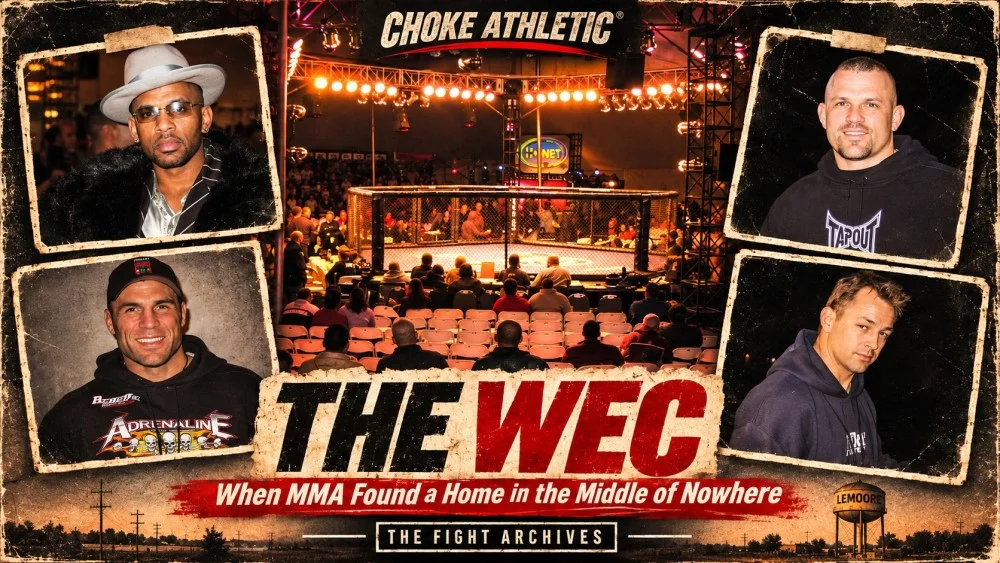
Before the sold-out arenas, television contracts, and mainstream acceptance, World Extreme Cagefighting brought something special to a dusty corner of California’s San Joaquin Valley. If you were there, you know exactly what I’m talking about.
Let me get something out of the way before we go any further. If you’re expecting these stories from The Fight Archives to follow some neat chronological order, you’re probably going to be disappointed. That’s not how my memory works. One day, I’ll remember something from 1995, and the next, something from 2006 will pop into my head. Occasionally, I’ll remember something that happened thirty years ago but couldn’t tell you what I had for breakfast yesterday. That’s just how it goes. So don’t expect these stories to follow any particular timeline. They don’t in my head, and they’re not going to here either.
Which brings me to a little organization called World Extreme Cagefighting, better known as the WEC. For those who remember it, just mentioning those three letters probably brings back some great memories. For those who came into mixed martial arts after it became a mainstream sport, you might be surprised to learn just how important this unlikely little promotion was. And where it all happened makes the story even better.
When the UFC Wasn’t Quite So Ultimate
To understand why the WEC was so special, you have to remember what was happening in mixed martial arts around the turn of the millennium. The UFC had been around since 1993, and those first events were unlike anything most American sports fans had ever seen. Different martial arts disciplines, fighters of wildly different sizes, minimal rules, and the constant question of what would happen when a boxer faced a wrestler, or a karate practitioner faced a Brazilian Jiu-Jitsu fighter. It was fascinating stuff, but by the late 1990s, much of the novelty had worn off. The original sideshow appeal that had attracted so much attention was fading, and the UFC was struggling to figure out what it wanted to become.
People who only know today’s UFC have absolutely no idea how bad things got. We’re talking about a time when the organization was holding events in small casino venues (or even river barges), sometimes in front of fewer than 2,000 people. The UFC that now sells out major arenas was once putting on fights in places that could barely accommodate a decent-sized high school graduation. Think about that for a minute. Semaphore Entertainment Group, better known as SEG, had originally owned and promoted the UFC. By the end of its run, the company was in serious financial trouble, and the organization had lost much of its momentum. My personal opinion? SEG had either lost interest in its shiny new toy or simply run out of ideas about what to do with it. Probably a little of both.
To be fair, the UFC was also fighting political battles, television distribution problems, and regulatory opposition that made survival difficult. But from the standpoint of someone who loved the sport, it was frustrating watching something with so much potential struggle to find its footing. Zuffa purchased the UFC in 2001, but the spectacular growth that people associate with the modern UFC was still years away. Even the new owners had a difficult road ahead. Meanwhile, something interesting was happening a few hours away from the bright lights of Los Angeles, something that, in my opinion, deserves a lot more recognition than it gets.
An Unlikely Hero Emerges in Lemoore, California
If someone had told you in 2001 that one of the most exciting things happening in American mixed martial arts would emerge from an Indian reservation in the middle of California’s hot, dusty San Joaquin Valley, you probably would have questioned their judgment. Lemoore, California, wasn’t exactly Las Vegas. There weren’t enormous entertainment districts, world-famous fight venues, or glamorous nightlife destinations waiting for the next big sporting spectacle. What it did have was the Palace Indian Gaming Center, later known as the Tachi Palace Hotel & Casino, on the Santa Rosa Rancheria of the Tachi Yokut Tribe. And that turned out to be exactly what mixed martial arts needed.
At the time, MMA still faced enormous regulatory problems in California. The state hadn’t established a workable system for sanctioning MMA events outside tribal jurisdictions, and Native American sovereign land offered promoters an opportunity to hold fights that were otherwise extremely difficult to organize legally within the state. It seems almost ridiculous today, considering how thoroughly MMA has become part of mainstream American sports, but that’s where we were. Scott Adams and Reed Harris founded World Extreme Cagefighting in 2001, and the organization’s first event took place on June 30 of that year. Dan Severn faced Travis Fulton in the main event, which was a pretty respectable way to get started for an organization trying to establish itself in the middle of the valley. Christian Printup was another important part of making those early events happen, helping bring together the promotion and the people who made it work.
And work it did. In a place where you might have expected a few hundred curious spectators, the WEC began attracting thousands. The first event alone reportedly drew around 4,000 people, and I remember later crowds growing to more than 5,000 making their way to Lemoore for these events. Five thousand people! Now, that might not sound especially impressive when you compare it to the attendance at a modern UFC event, but you have to understand the time and circumstances. We weren’t talking about a major metropolitan area with millions of potential ticket buyers living twenty minutes away. We were talking about people traveling into the San Joaquin Valley to watch fighters compete inside a cage, and they weren’t coming for some polished Hollywood production. They came because they loved fighting.
When Fighters and Fans Were Almost Family

This is probably what I remember most fondly about those WEC days. The separation between fighters and fans simply wasn’t what it is today. These days, professional fighters can be surrounded by managers, publicists, security people, media obligations, and all the machinery that comes with being a recognizable sports personality. Back then, things were considerably more personal. You could see people who were about to step inside the cage interacting with the same fans who would be cheering for them a little later. Fighters, trainers, promoters, and spectators weren’t always divided into separate worlds. There was a genuine sense of community, and many of the people attending weren’t simply spectators looking for a few hours of entertainment. A lot of them trained, others knew the fighters personally, and some had been following the sport since the earliest UFC events.
Some of the biggest names in the sport were around, too. Randy Couture, Chuck Liddell, and just about everyone who was anyone in the fighting world seemed to turn up at one point or another. You could be watching a fight and realize that someone whose name you knew from the UFC was sitting among the crowd or talking with people nearby, and nobody acted like it was particularly unusual. You didn’t have to purchase some ridiculously priced VIP experience to feel connected to the sport. Just being there was often enough. It reminded me of the old martial arts community, where people might travel hundreds of miles to train together, exchange ideas, watch each other compete, and then spend the evening talking about fighting.
Of course, there were rivalries, egos, and plenty of colorful personalities. Not everybody was going to become lifelong friends, and some of those characters probably weren’t people you’d want to bring home to meet your mother. But underneath all of that was a shared appreciation for what we were doing. We were part of something that most of the outside world still didn’t understand, and in a strange way, I think that made it even better. There was something almost electric about those events, not because of elaborate production or expensive entertainment, but because the fights mattered to the people watching them. And the fighters knew it.
The Fights Were Pretty Damn Good, Too
Nostalgia is a funny thing. Sometimes we remember the atmosphere surrounding an event more fondly than the actual event itself, but that isn’t the case with the WEC. The fights were often outstanding. Remember, this was before every professional fighter followed essentially the same training formula. Cross-training had become increasingly common, and the sport was evolving rapidly, but there were still significant differences in how fighters approached competition. You had wrestlers developing striking games, submission specialists learning how to deal with increasingly sophisticated ground-and-pound, kickboxers adapting their techniques to the cage, and tough regional fighters who were simply willing to fight anybody. Some were already highly accomplished athletes. Others were hungry newcomers looking for an opportunity to make a name for themselves. And some were just plain characters.
The WEC gave those fighters a place to compete at a serious level, and its early cards included established names and future stars. Frank Shamrock returned to competition at WEC 6 in 2003, while fighters such as Chris Leben, Mike Swick, and many others spent time competing in the organization. Later, as the WEC evolved, it became especially famous for showcasing lighter-weight fighters, eventually helping elevate names such as Urijah Faber, José Aldo, Miguel Torres, and Dominick Cruz. But that’s the version of the WEC that many newer fans remember. For me, the original Lemoore years will always have a special place. There was a rawness to those events that you simply can’t manufacture with a bigger budget. The people were real, the fighters were real, and the competition was real. You never quite knew what was going to happen next, which was part of the reason we kept coming back.
And Then There Was Lodune Sincaid
Of course, no discussion of my WEC memories would feel complete without mentioning my old friend Lodune Sincaid. If you’ve been following The Fight Archives, you already know that Lodune was one of the more unforgettable characters I encountered during those years. I’d previously written about the circumstances surrounding his selection for the first season of The Ultimate Fighter, which was a pretty wild story in its own right. But Lodune’s fighting career didn’t end with that television appearance. He eventually went on to become the WEC Light Heavyweight Champion. On May 5, 2006, at WEC 20 in Lemoore, Lodune defeated Dan Molina by rear-naked choke in the first round to capture the championship.
Think about that for a moment. Here’s a guy whose life had taken more than a few unexpected turns, who appeared on a television show that would help change the sport, and who ultimately found himself wearing a championship belt. That’s quite a journey, and knowing Lodune personally made that achievement especially meaningful. There were plenty of talented fighters in those days who never received the recognition they deserved. Some were brilliant athletes who happened to arrive too early in the sport’s development, while others had the skills but never quite found the right opportunity. Lodune managed to put his name into the WEC championship record books, and whatever else happened in his life, nobody can take that away from him.
What Happened to the Original WEC?
Like just about everything else in this sport, the WEC eventually changed. In December 2006, Zuffa, the parent company of the UFC, purchased the organization. The WEC continued operating under its own name, but the acquisition marked the beginning of a different chapter. The promotion moved away from its original Lemoore home, changed its presentation, and increasingly focused on lighter-weight divisions that weren’t receiving the same level of attention in the UFC. That version of the WEC produced some incredible fights and helped develop some of the finest fighters the sport has ever seen. I don’t want to take anything away from it. In fact, the later WEC did some things exceptionally well, especially demonstrating that lighter-weight fighters could deliver some of the most exciting competition in mixed martial arts.
By the end of 2010, the WEC’s run had come to an end, and its remaining divisions and fighters were brought into the UFC. From a business standpoint, you can understand why it happened, but something was lost along the way. Not necessarily the quality of the fights, and certainly not the talent. What disappeared was that particular atmosphere of the original Lemoore events, the sense that you had stumbled into something special before the rest of the world discovered it. It wasn’t a matter of newer MMA being worse. It was simply different, and the circumstances that had made those early WEC events so memorable were never going to exist in quite the same way again.
Some Things Were Better Before They Got Bigger
I don’t want this to sound like another old guy complaining that everything was better back in his day. Although, now that I think about it, maybe that’s exactly what I’m doing. But I don’t believe every aspect of early MMA was better. Fighters today are generally more well-rounded, the sport has developed considerably, and athletes have opportunities that simply didn’t exist when we were starting out. Those are good things. Still, there’s a difference between appreciating how far something has come and forgetting what made you fall in love with it in the first place.
For me, the original WEC represents an era when mixed martial arts still felt like a close-knit community of fighters, trainers, promoters, and fans who shared an unusual passion. It wasn’t mainstream, it wasn’t particularly glamorous, and it certainly wasn’t predictable. It was a bunch of people gathering on tribal land in the middle of California’s San Joaquin Valley to watch some of the best fighting you could find anywhere. And somehow, against all reasonable expectations, it worked. More than that, it was magical.
When I look back on those years, I don’t just remember the fights or the famous names. I remember the atmosphere, the people, and the feeling that we were all participating in something extraordinary. It was an awesome time to be a fighter, an awesome time to be a fan, and an awesome time just to be alive. And if you were fortunate enough to be there, I suspect you know exactly what I mean.
From The Fight Archives — Choke Athletic
Choke Athletic was originally established in 1994, during the early days of No Holds Barred fighting, Vale Tudo, and submission fighting. The original brand operated until 2001 and was revived in 2026.
The Fight Archives is where I share my personal memories of the fighters, characters, events, and experiences that helped shape those early years. Some stories will be funny, others might be a little rough around the edges, and as you’ve probably figured out by now, they won’t necessarily be told in chronological order.
Were you at any of the original WEC events in Lemoore? I’d love to hear your memories. Who did you go to watch? What fights stand out? And do you remember that atmosphere the same way I do?
Visit ChokeAthletic.com and follow along as we continue revisiting the early days of the sport.
Keeping the Original NHB Spirit Alive
Choke Athletic began making No Holds Barred fightwear in 1994, back when MMA was still finding its identity. The original brand operated until 2001, and we brought it back in 2026 to preserve a little of what made those early years special.
If you appreciate the history behind the sport, take a look at our original-style No Holds Barred T-shirts and our complete vintage MMA apparel collection.
The clothes are new. The roots go back to 1994.